The speed story misses the bigger shift
Early impressions tend to focus on acceleration. Drafts appear instantly, summaries land before anyone asks for them, and queues look unusually tidy. On the surface, work feels lighter.
But that impression fades quickly. The real change isn’t simply that tasks move faster—it’s that less effort is required to produce a “complete-looking” starting point. Once that exists by default, the job shifts toward evaluating outputs rather than creating them.
That shift introduces a subtle tension. Work appears closer to finished, yet more time gets spent checking whether it should be trusted in the first place. The system feels efficient, but the mental load doesn’t necessarily disappear—it relocates.
Capability expansion changes what counts as a team

AI output often arrives in a form that resembles final work: structured, formatted, and ready to forward. That creates a perception that capacity has increased without changing headcount.
In practice, what changes is not just speed but scope. Tasks that previously required deliberate effort—drafting messages, summarizing threads, proposing next steps—become automatic outputs. As a result, more of the workflow depends on material that no single role fully authored.
This expands what a team is effectively responsible for. Workflows now include machine-generated drafts that sit between roles, and those drafts begin influencing downstream decisions even before anyone explicitly validates them. The boundary between assistance and authorship becomes less visible.
More output doesn’t reduce work—it redistributes it
A common assumption is that automation removes workload. In reality, it often redistributes it across more touchpoints. When generating text becomes inexpensive, more “almost-ready” artifacts appear across the system: draft plans, preliminary summaries, suggested actions. Each one looks usable enough to move forward, which increases the number of items entering review and coordination loops.
Instead of fewer tasks, teams face more intermediate states. Work that used to be clearly incomplete now arrives in a condition that feels nearly done, which changes how decisions get made. Items move forward earlier, sometimes before all necessary context has been consolidated.
The pressure shifts from producing output to deciding what deserves attention first.
Coordination becomes the new bottleneck, not effort
As generation becomes easier, alignment becomes harder. The main friction is no longer writing or assembling information—it is ensuring that multiple people interpret AI-generated content in the same way.
A single draft can trigger different assumptions across roles. One person may treat it as ready to act on, while another sees it as provisional. Small ambiguities then turn into coordination overhead: clarification messages, re-checking steps, and repeated confirmations.
The system may look faster overall, but more effort is spent synchronizing interpretation than before. The result is not failure, but drift—work that moves forward while quietly accumulating misalignment.
Automation introduces “false completion”
One of the more difficult effects of AI-generated work is its appearance of closure. Outputs are often structured in a way that implies completeness even when underlying inputs are partial or uncertain.
That appearance can influence behavior. Downstream users may treat a polished draft as already validated, reducing the likelihood of asking clarifying questions that would normally surface missing details. Once that happens, errors are not corrected at the point of creation—they propagate through reuse.
The key issue is not that mistakes occur, but that they become easier to carry forward without friction. The smoother the output, the less visible the need for verification becomes.
Quality shifts from craftsmanship to governance
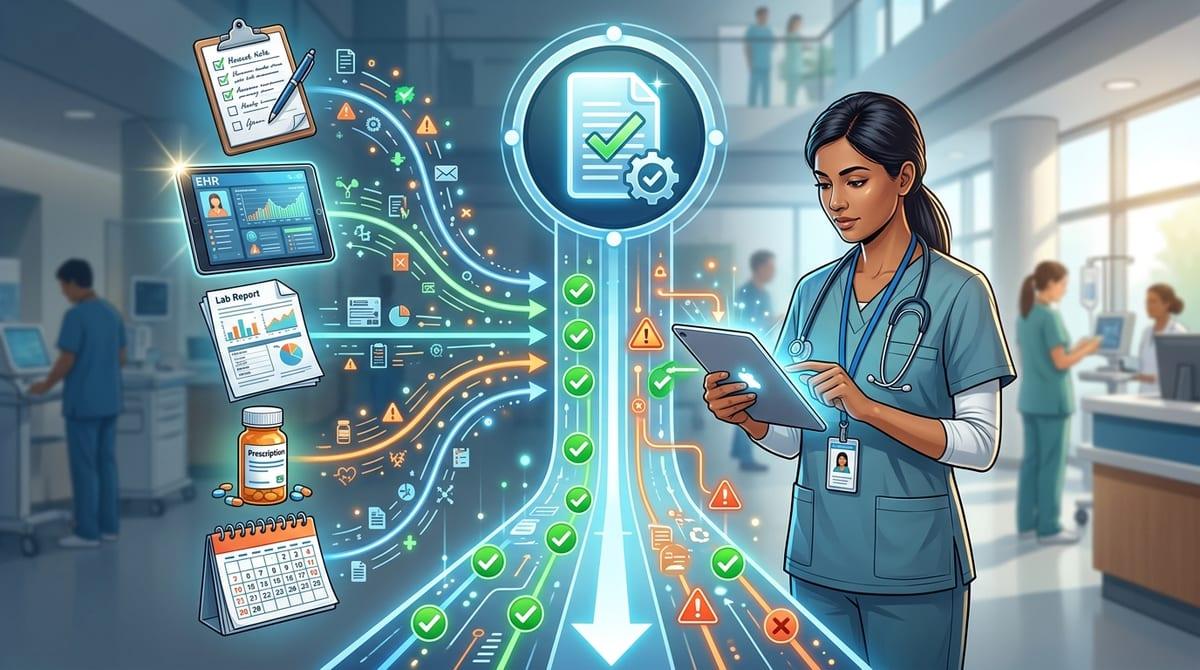
As drafting becomes automated, quality shifts away from individual craftsmanship and toward system design. Instead of focusing on how well a single output is written, attention moves to how reliably inputs are shaped, filtered, and validated before they generate downstream effects.
This introduces a different kind of responsibility. Teams are no longer only producing content; they are defining the rules under which content is generated and reused. That includes deciding what sources are allowed, what must be verified, and where outputs are permitted to trigger action.
In this environment, quality issues are less about wording and more about process gaps. A well-written output can still be incorrect if it originates from incomplete or misaligned inputs.
A revised understanding of leverage and responsibility
A noticeable change emerges when output volume increases but attention feels more strained. Work appears lighter because fewer steps are manually executed, yet more effort is spent reviewing, validating, and tracking what has already been generated.
This creates a different form of dependency: attention becomes the limiting resource rather than execution. Instead of spending time producing work, teams spend more time detecting inconsistencies between outputs and underlying context. Detection is inherently different from creation. It requires comparing generated content against dispersed knowledge—context that may not be fully present in a single view. When that context is incomplete, even high-quality outputs require additional cognitive effort to verify.
As AI becomes embedded in workflows, the most important question shifts from “what should be produced” to “who confirms it is correct.” Without explicit ownership of verification points, responsibility tends to diffuse. One role assumes another has checked the output, and errors can pass through multiple stages without direct acknowledgment. This is not a failure of intent but a structural side effect of fast-moving systems. Clear checkpoints reduce this ambiguity. When it is explicitly defined where validation occurs, work stops depending on assumption and becomes anchored in traceable review points.
The visible change is speed, but the more important change is structural. Work is no longer a linear path from input to output; it becomes a sequence of generation, interpretation, and validation steps distributed across people and systems. That structure increases overall capability, but it also increases dependence on alignment. Teams gain the ability to produce more, but must also manage more states of partial completion.
The result is not simply faster work. It is a different shape of work—one where value is determined less by how quickly something is created and more by how reliably it can be interpreted, verified, and carried forward without distortion.