From tool fantasy to thinking partner reality
It often starts late in the day: a guideline update lands, the inbox refills, and the same sentence gets rewritten three times because it still doesn’t feel safe. The draft from a model reads so smooth that it briefly quiets the mental noise—until the unease returns when you realize you can’t remember which parts you actually checked.
That shift matters. When the model is treated like a power tool, the goal is speed, and the brain tends to “accept and move on” under fatigue. Fluency becomes a shortcut cue for correctness, which can lower the impulse to verify—even when the stakes are patient-facing and the team’s confidence feels inconsistent.
When it’s treated more like a thinking partner, the output becomes scaffolding: a place to externalize options, compare phrasing, and surface what still needs review. The work may feel slower at first, but it can reduce rumination because the uncertainty is organized instead of suppressed.
Why people attribute agency to fluent text
There’s a small “settling” feeling when the wording arrives polished, like the room got quieter for a second. Under deadline pressure, that ease can be misread as the work being finished, even while a part of you notices you can’t quite explain why the recommendation is framed that way.
Fluent text pushes a few predictable buttons in the brain. Readability can act like a credibility signal, so the mind spends less effort generating alternatives and less effort looking for gaps. When you’re cognitively loaded, that matters: the usual friction that triggers verification (awkward phrasing, missing qualifiers, internal inconsistency) is reduced, so the “check it” impulse may not fire even when uncertainty is still present.
Agency gets layered on because the output arrives in complete, confident sentences, as if a stable viewpoint chose them. In reality, it’s easy for the team’s own partial decisions—what you asked, what you omitted, what you hoped was true—to get reflected back and feel external. If the calm that comes with fluency is doing most of the convincing, it’s a quiet sign to slow down before trust runs ahead of review.
Three starter models: mirror, intern, simulator
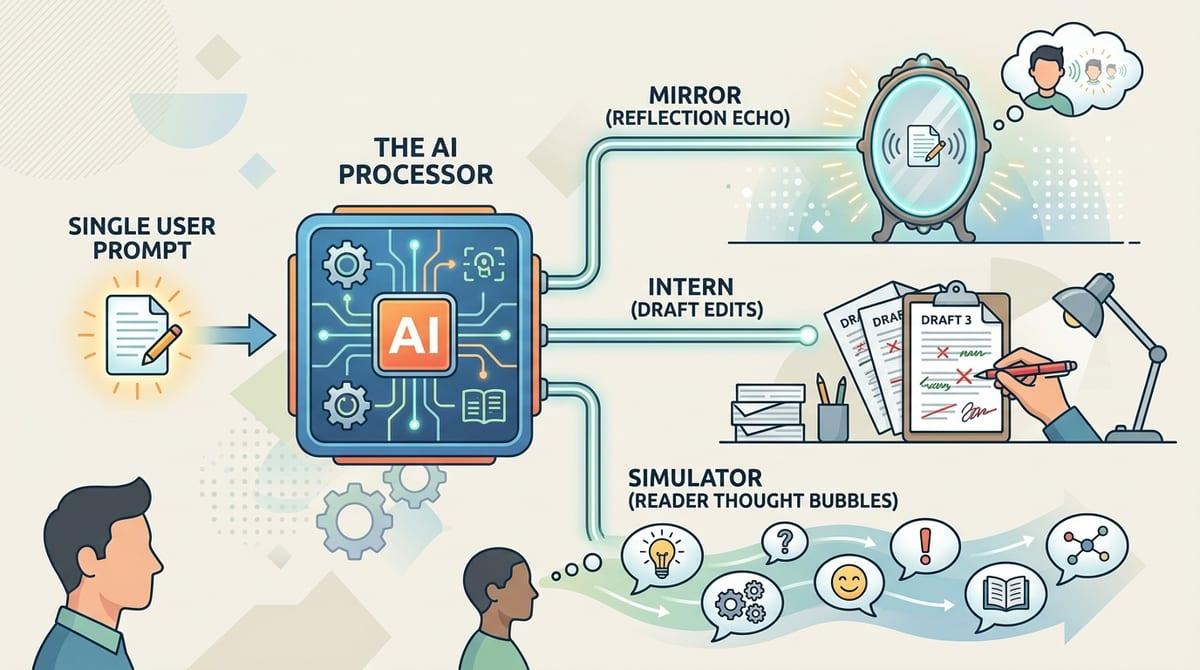
Sometimes the first sign you’ve slipped into a pattern is a tiny jolt of doubt: the model’s sentence sounds right, but your confidence doesn’t rise with it. In that moment, teams are usually using one of three “starter” mental models, and the mismatch between the model and the task can create quiet inconsistency—more reruns, more edits that don’t feel like progress.
The mirror model shows up when prompts are written like a partially formed thought (“make this clearer,” “tighten this”), and the output reflects your assumptions back in a cleaner shape. That can feel relieving under load, but it also means gaps in the team’s own reasoning can come back as fluent certainty. The mechanism is simple: you recognize your intent in the phrasing, and recognition gets misread as verification—even when no new evidence was introduced.
The intern model feels different: you expect drafts, options, and occasional errors, so you stay in supervisor mode. The simulator model is closer to rehearsal—“if we say it this way, what will readers infer?”—and it can surface downstream misinterpretations, though it may also produce plausible reactions that aren’t consistent. When fatigue is high, noticing which model you’re in can explain why checking suddenly feels like extra effort instead of part of the workflow.
The adversary model that stress-tests reasoning
Sometimes the first real warning sign is a faint tightening in your chest when the draft looks “done,” but you can’t defend it out loud. That’s often when an adversary stance helps—not because the model is right, but because it reliably makes the reasoning feel less comfortable.
In the adversary model, you ask it to argue against your plan: list failure modes, point out missing qualifiers, and identify what a skeptical clinician or patient might challenge. The internal shift matters. Under load, the brain tends to protect a near-finished draft (confirmation bias), and fluent wording lowers the friction that would normally trigger a check. An adversarial prompt reintroduces friction on purpose, so gaps become harder to ignore.
It can feel inefficient, and sometimes overly critical, but the tension is information: if the “pushback” is easy to answer, confidence tends to become steadier for the right reasons.
What drives adoption patterns beneath the surface

After a few weeks, you may notice a strange split: the team is producing more copy, but the feeling of being “caught up” never quite arrives. People open the model reflexively—sometimes before they’ve even decided what question they’re trying to answer—and that automatic reach can happen even while confidence stays uneven.
Part of what’s happening is effort budgeting. Under sustained cognitive load, the brain starts treating certain steps as optional, especially the ones that feel mentally expensive and socially risky (like re-reading source material or asking for a second set of eyes). A fluent draft reduces the discomfort of uncertainty in the moment, so it gets used as a quick emotional reset. The trade-off is subtle: the calmer you feel, the less your mind generates competing options, and fewer options can make a weak rationale feel “settled.”
Adoption also spreads through reinforcement, not evaluation. If the model helped once during a tense deadline, the memory of relief can become the deciding factor the next time—even if the hidden cost is more retries, fewer checks, and a growing sense that accuracy work now takes extra effort.
Three coordination models: librarian, moderator, auditor
There’s a particular kind of tiredness that shows up when three tabs are open, two people are asking for “just a quick tweak,” and the question in your head is no longer “what’s true?” but “where did we already decide this?” That’s usually when teams stop using the model to generate wording and start using it to coordinate work—because coordination is what breaks first under load.
In the librarian model, the model is treated as a sorting desk: pull out the relevant chunks, restate them in a usable order, and keep track of what came from where. The relief comes from reducing working-memory strain—less mental juggling, fewer half-remembered details. The risk is a quiet misinterpretation: when the information is reorganized smoothly, it can feel like it was validated, even if it was only re-packaged.
The moderator model appears when disagreement is the bottleneck. You ask the model to surface points of alignment, list trade-offs, or propose wording that different stakeholders can live with. That can lower social friction, but it can also blur responsibility: a compromise sentence may read “reasonable” while still being vague enough to hide an unresolved clinical decision.
The auditor model is more uncomfortable by design. You use it to scan a near-final draft for missing qualifiers, internal contradictions, and places where a patient could overgeneralize. It doesn’t remove uncertainty; it organizes it into a checklist-shaped problem—if the team finds themselves resisting that step, it’s often a signal that fluency has started to feel like closure.
When a helpful model creates unexpected discomfort
The discomfort usually shows up after the “good” output: a slightly buzzy, over-alert feeling while you reread, as if your eyes are moving faster than your judgment. The draft sounds aligned, but your confidence lags behind it, and that gap can feel like a personal failure instead of a workflow signal.
One driver is a mismatch between fluency and memory. When the model supplies the connective tissue—transitions, qualifiers, even the structure—your brain may encode less of the reasoning chain. Later, when someone asks, “Why are we saying it this way?” you can’t retrieve the steps, so the body treats it like risk. That’s not proof anything is wrong; it’s the cost of offloading.
Teams sometimes misread this as “the model is making us anxious,” when it may be exposing a thinner verification layer. If that uneasy feeling keeps returning, it can be a quiet cue to decide whether you want the model to reduce effort, or to make uncertainty visible before it ships.