Big news for anyone working with large language models: Databricks and Hugging Face have joined forces to speed things up by as much as 40%. That's right. Training and fine-tuning your models just got a whole lot more efficient, thanks to this collaboration. Whether you're building applications, experimenting with custom datasets, or optimizing performance, faster model development means quicker iteration and better results. The best part? You don’t need to be an infrastructure expert to take advantage of it. But what’s really going on under the hood? Let’s break it down.
Why This Partnership Matters

If you've ever had experience with big language models, you understand it's no small undertaking. The training is time-consuming, the tuning is a waiting game, and the infrastructure? More than a minimal configuration. So when Databricks—wholly known for its cloud platform for data—is paired with Hugging Face—the leading open-source models and tools company—it produces something that needs to be heard.
Here’s the simple version: Databricks offers a managed, scalable infrastructure. Hugging Face brings top-tier models and training libraries. Combined, they make the training process smoother, faster, and cheaper. But there’s more to it than shaving off time.
The Technical Shift That Makes the Difference
This isn’t just about combining brand names. The real story lies in the tools and setups now available to developers and researchers. Here’s where the upgrade becomes clear.
1. Pre-Built Integration with Hugging Face on Databricks
Before this, running a Hugging Face model on a scalable cluster took some planning. Now, it's all lined up for you. Databricks now includes pre-installed Hugging Face libraries directly in its ML Runtime. That means there’s no more configuring or building containers just to start training. It’s plug-and-train.
With a few lines of code, you can load a model from the Hugging Face Hub, push it to your Databricks cluster, and begin training. And because Databricks handles distributed compute for you, scaling to more GPUs or nodes is no longer something you have to worry about.
2. Deep Integration with Accelerated Hardware
Databricks is also using optimized hardware, including NVIDIA A100s and other high-performance GPUs. Combined with Hugging Face’s Accelerate and Transformers libraries—both built to support mixed precision and distributed strategies—the result is much faster execution.
This matters because LLMs are not small. When training models like Falcon, Mistral, or even distilled BERT versions, every bit of speed improvement adds up. And when it comes to cost? Faster runs mean fewer hours on the meter.
3. Streamlined Data Pipeline
Another perk is that you don’t need to worry about moving data back and forth between services. With Databricks handling both the data and the model environment, everything stays in one place. This reduces I/O bottlenecks and data loading delays. You can load massive datasets using Spark, process them in-place, and feed them straight into the training pipeline without bouncing across tools or cloud accounts.
All of this leads to better throughput and consistency, which means your models train faster, and your codebase stays cleaner.
Training LLMs, Step-by-Step, the New Way
To really understand how the process has changed, let’s walk through the new workflow that this partnership enables. It’s now simpler, and that simplicity helps cut time while also making the process more stable.
Step 1: Set Up Your Cluster
Databricks now offers machine images with Hugging Face libraries pre-installed. You just choose your compute (like a GPU-enabled cluster), and that’s it—no manual setup required.
Step 2: Pull the Model and Tokenizer
Use Hugging Face’s transformers library right from your notebook or script:
python
CopyEdit
from transformers import AutoModelForCausalLM, AutoTokenizer
model = AutoModelForCausalLM.from_pretrained("gpt2")
tokenizer = AutoTokenizer.from_pretrained("gpt2")
This pulls the pre-trained weights and tokenizer in seconds. And because the libraries are up-to-date and optimized, you’re ready to train or fine-tune immediately.
Step 3: Load and Prepare the Dataset
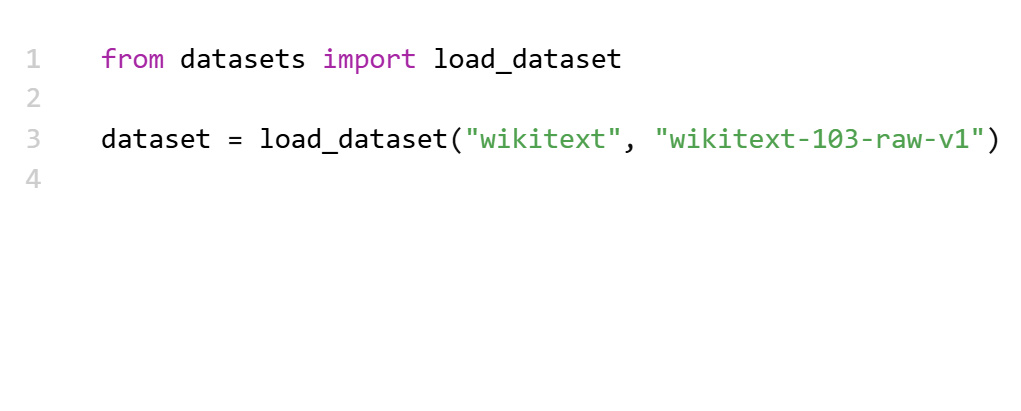
Databricks makes data handling more seamless. Whether you’re using the Hugging Face datasets library or your own Spark pipelines, you can clean, tokenize, and batch your data all within the Databricks environment.
python
CopyEdit
from datasets import load_dataset
dataset = load_dataset("wikitext", "wikitext-103-raw-v1")
Now the data flows straight into the pipeline—no exporting, converting, or uploading required.
Step 4: Accelerated Training
Once your model and data are ready, you can use Hugging Face Accelerate or Trainer APIs, both of which are supported on Databricks' infrastructure.
python
CopyEdit
from transformers import Trainer, TrainingArguments
training_args = TrainingArguments(
output_dir="./results",
per_device_train_batch_size=8,
num_train_epochs=3,
fp16=True,
logging_steps=10
)
trainer = Trainer(
model=model,
args=training_args,
train_dataset=tokenized_dataset["train"]
)
trainer.train()
This setup takes advantage of mixed-precision training, optimized GPU usage, and data parallelism—all of which contribute to the 40% speed improvement reported by Databricks.
Step 5: Push It Back to the Hub
Once you’ve finished training or fine-tuning, sending the updated model back to the Hugging Face Hub is just as easy. With built-in authentication and support in Databricks notebooks, there’s no manual step or credential juggling.
python
CopyEdit
model.push_to_hub("your-new-model-name")
tokenizer.push_to_hub("your-new-model-name")
Now your model is shareable, reusable, and public (or private, if you prefer)—ready for others to download and continue building on.
Wrapping It Up
So what's the takeaway? When two strong platforms meet with a shared goal, the result can be more than just a little boost. In this case, it's a 40% jump in speed, without adding cost, complexity, or extra tools.
The Databricks and Hugging Face partnership is not about flashy marketing. It’s a well-thought-out improvement to a process that a lot of people rely on. If you’re already working with large language models or plan to, it’s worth giving this new integration a try. You’ll likely find yourself getting more done, in less time, with fewer things to fix along the way.